EMCON 2026 - Clinical Conundrum Guidelines
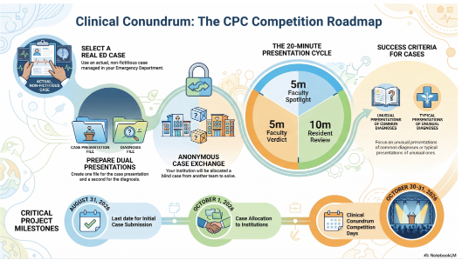
CLINICAL CONUNDRUM - The Clinical Pathological Case (CPC) competition is a collaborative medical event designed to enhance critical thinking and peer discussion within Emergency Medicine.
Each participating hospital contributes a challenging, real-world case consisting of a patient’s history and medical findings while keeping the final diagnosis anonymous. These cases are then swapped between institutions, requiring a resident to analyze the data and logically determine the correct medical conclusion.
The event follows a structured format where faculty members introduce the mystery and later reveal the final verdict after the resident's presentation. To ensure educational value, participants must follow specific timelines and use provided templates to submit complex yet solvable clinical scenarios.
This competition serves as an interactive teaching tool that shifts the focus from individual performance to collective institutional problem-solving.
An ideal case for the Clinical Conundrum competition is characterized by its clinical relevance, logical structure, and educational value. According to the guidelines, the following elements define an ideal submission:
- Diagnosis Type: The best cases typically feature unusual presentations of common diagnoses or typical presentations of unusual diagnoses.
- Complexity Level: While the case should be interesting and challenging, highly complex cases involving multiple diagnoses are best avoided.
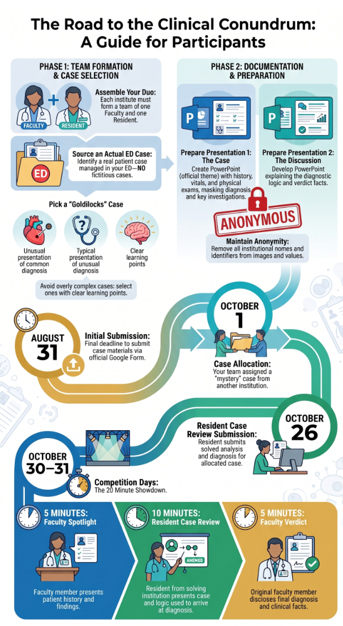
- Authenticity: The case must be an actual case seen and managed in the submitting institution's Emergency Department. Fictitious cases or those sourced from the internet or other institutions are not permitted.
- Relevance and Logic: The case must be relevant to the Emergency Medicine context. It should be structured to allow for a logical approach, enabling participants to discuss differential diagnoses and arrive at the correct diagnosis based on the information provided.
- Educational Value: Ideal cases have good learning points and provide an opportunity to encourage diagnosis primarily through history and clinical examination findings.
- Solvability: The Conundrum Council may disqualify any case they deem unsolvable or non-compliant with formatting guidelines.
To ensure the case is suitable for competition, it must include detailed history, vital signs, physical examination findings, and all relevant investigations (with institutional names removed and final reports masked).
Participating institutions are required to prepare two PowerPoint presentations using the provided theme. The specific information to include in each is as follows:
1. Case Presentation (Without the Diagnosis)
This presentation is used during the "Faculty Spotlight" to introduce the case to the competition. It must include:
- Patient History: Chief complaint, history of present illness, past medical and surgical history, social history, medications, and allergies.
- Clinical Findings: Detailed vital signs and physical examination findings. The sources emphasize including key clinical examination findings, as the competition encourages diagnosis based on history and physical exams.
- Investigations: All relevant diagnostic study values or images.
- Crucial Note: These must be provided without the final report or inference, and all institutional names must be removed.
- Strategy: A key investigation may be intentionally masked for the purposes of the competition.
2. Discussion and Faculty Verdict
This presentation is used after the resident from the opposing team has attempted to solve the case. It should contain:
- The Diagnosis: A clear disclosure of the final diagnosis.
- Explanation: A detailed explanation of the relevant facts and the logical path taken to reach that diagnosis.
Both presentations must be completely anonymous; they should not identify the submitting institution.
Participation Outline:
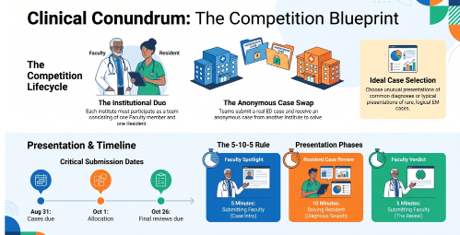
- One faculty & one resident from each institute will be taking part in the CPC competition
- FACULTY SPOTLIGHT – The faculty will introduce the case that has been submitted by their institution.
- RESIDENT CASE REVIEW -The resident from the institution that this case has been given to will then present the case and arrive at the diagnosis.
- FACULTY VERDICT -The faculty from the institution that has submitted the case will then disclose the diagnosis with the relevant facts that has led to that diagnosis.
Presentation timelines
- Faculty Spotlight – 5 Minutes
- Resident Case Review – 10 Minutes
- Faculty Verdict – 5 minutes.
The expectations that define success for both the submitting institution and the reviewing resident:
Resident Evaluation Criteria
While a specific score breakdown isn't provided, the resident's performance is centered on their ability to:
- Arrive at the correct diagnosis based on the information provided by the opposing team.
- Demonstrate a logical approach to the case.
- Discuss a comprehensive list of differential diagnoses.
- Utilize history and clinical examination findings as the primary drivers for reaching the diagnosis.
Case Submission Quality
The quality of the case submitted by an institution is also a factor, as the "Conundrum Council" evaluates cases for:
- Clinical Relevance: The case must be relevant to the Emergency Medicine context.
- Educational Value: The case should have "good learning points" and facilitate peer discussion.
- Complexity and Logic: The best cases feature unusual presentations of common diagnoses (or vice versa) and must be "solvable" through a logical clinical path.
- Adherence to Format: Cases can be disqualified if they are deemed unsolvable or non-compliant with formatting guidelines, such as failing to mask institutional names or final investigation reports.
Presentation Performance
Participants are also bound by strict presentation timelines, which will influence the overall assessment.
KEY TIMELINES:
Last date for Initial Case Submission – 31st August 2026.
Case allocation date – 1st October 2026.
Resident Case Review Final submission date 26th October 2026
CLINICAL CONUNDRUM Competition- 30th & 31st October 2026
How to participate:
- Use the ppt theme and prepare the case
- Submit via google form